Angels Landing, Zion National Park
- Spring (March to mid-May) and fall (mid-September to November) offer the most comfortable temperatures and smaller crowds, making them the ideal seasons to visit.
- Whatever the season, start as early in the morning as possible and aim for the first shuttle of the day to beat the heat, avoid long lines, and reduce congestion on the chain sections.
- The hike covers 5.4 miles round trip with 1,500 feet of elevation gain and takes most hikers 3 to 5 hours to complete. Along the way you pass Walter's Wiggles, a set of 21 switchbacks, before a steep and narrow ridge leads to a viewpoint 1,500 feet above Zion Canyon.
- A permit is required for anyone hiking the half-mile chain section from Scout Lookout to Angels Landing, at all times of day and all times of year, available through a seasonal or day-before lottery on Recreation.gov.
- During shuttle season, the park shuttle is free: park at the Zion National Park Visitor Center and ride to stop 6 (The Grotto), where shuttles run about every 5 to 10 minutes. When the shuttle is not running, you can drive Zion Canyon Scenic Drive to The Grotto and other canyon trailheads. If the visitor center lot is full, park in Springdale and catch one of the free town shuttles to the park entrance.
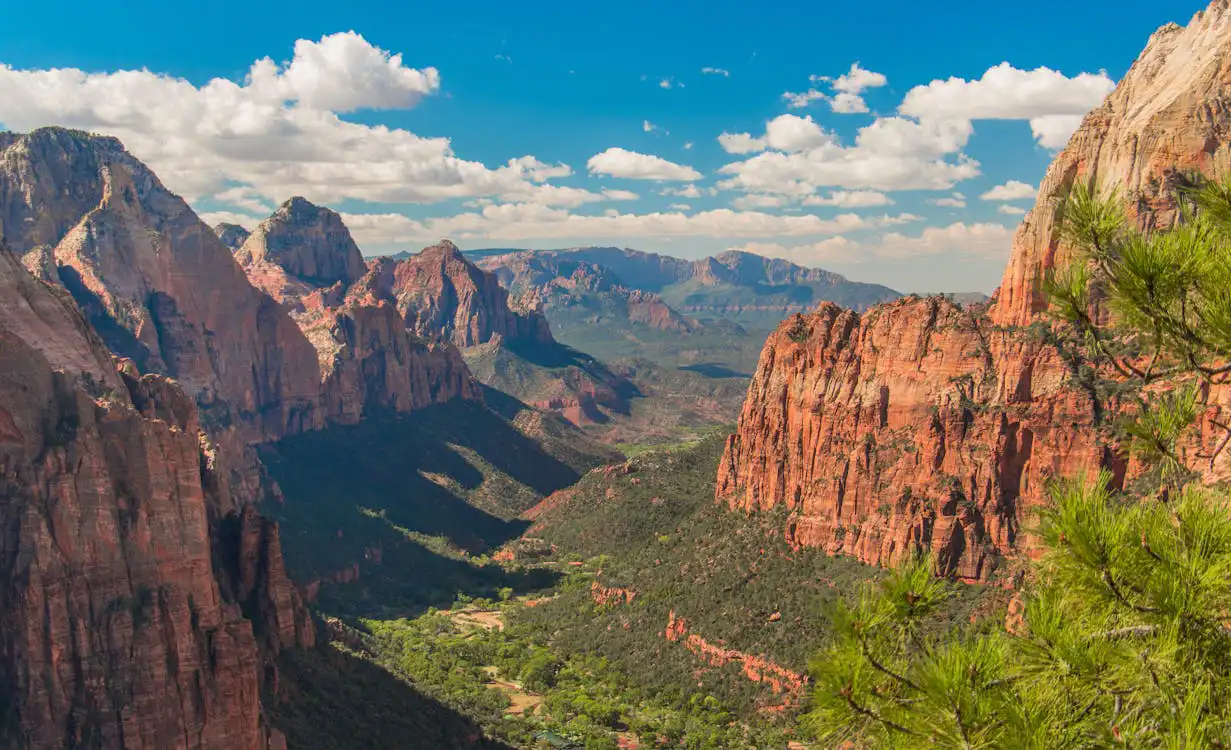
Angels Landing puts you at the center of Zion Canyon, 1,488 feet above the canyon floor, on a narrow fin of Jurassic age Navajo Sandstone. The rock beneath your feet is the same compressed desert dune that formed some 180 million years ago, and the walls surrounding you display the results: bands of red, orange, and white sandstone rising over 2,000 feet on either side.
From the summit, the Virgin River traces a pale green ribbon far below, its water still actively cutting into the canyon floor. The scale is difficult to absorb all at once. Landmarks like the Great White Throne and Red Arch Mountain anchor the horizon, while the entrance to the Narrows pulls your eye north up the canyon.
The vegetation at the top is sparse and low. Pinyon pines take hold in cracks in the rock, their roots finding purchase where little else can grow. Lower on the trail, cottonwoods and willows crowd the riparian zone along the river, forming a green corridor that contrasts sharply with the surrounding desert. Peregrine falcons are a regular presence here, riding thermals above the canyon walls. Rock squirrels work the sunny ledges below the summit.
The wind picks up on the exposed ridge. The air carries the dry, mineral scent of warm sandstone. Sound travels differently here: voices from hundreds of feet below reach you clearly, and the canyon amplifies the calls of ravens overhead. This guide covers everything you need to plan your visit, from the permit lottery to trail conditions by season.
Visiting Angels Landing
Getting there
The trail starts at the Grotto Trailhead, the 6th stop on the Zion Canyon Shuttle. From the stop, cross the road and the hiker's bridge over the Virgin River. Take a right hand turn onto the West Rim Trail. During most of the year private vehicles are not allowed on Zion Canyon Scenic Drive, so the park shuttle is your primary way in. A permit is required at all times of day and all times of year to go past Scout Lookout onto the chained section of Angels Landing. You do not need a permit to hike to Scout Lookout or continue on the West Rim Trail. Apply through either the Seasonal Lottery or the Day before Lottery on Recreation.gov.
When to go
Spring and fall are the most favorable seasons to visit Angels Landing. Fall brings golden trees against red cliffs while spring offers softer light. Early morning and late afternoon produce the most interesting light, with one side of the canyon cast in shadow. Because the canyon walls are so tall, the sun takes time to clear the ridgelines after sunrise, so the quality of light shifts fast. Summer temperatures regularly top 100°F, so if you're visiting in the warmer months an early morning start is your best option.
Details worth noticing
The trail passes through Refrigerator Canyon, a narrow hanging canyon where temperatures stay noticeably cooler than the surrounding terrain. Look up at the sandstone walls here where small alcoves pocket the rock face. The area around Refrigerator Canyon serves as habitat for Mexican Spotted Owls, one of the larger owl species in North America. Just below Scout Lookout, Walter's Wiggles are a series of 21 steep switchbacks associated with Walter Ruesch, Zion's first custodian and later acting superintendent, who helped engineer the Angels Landing route in the mid 1920s. They're a good reminder that the trail itself is as much a feat of human craft as it is a route through the canyon.
Insider Tips
Skip the summit for Scout Lookout
Once you reach Scout Lookout at the top of Walter's Wiggles, resist the pull toward the chains and instead walk to the east edge of the platform. From here you get a clear sightline looking down the full length of Zion Canyon with the Virgin River threading through the canyon floor below. The light hits this angle well in the morning and you won't be competing for space the way hikers do on the narrow summit ridge.
Wear grip soles, not trail runners
The sandstone on the chains section changes character depending on weather. Dry rock gives decent traction but any moisture turns it glassy fast, so stiff soled hiking boots with a deep lug pattern are worth the extra weight. Bring a light wind layer too since the exposed ridge above Scout Lookout sits well above the canyon floor and temperature drops noticeably once you clear the wall.
Stop at River Rock Roasting Co. in La Verkin
About 20 minutes out from the park on Highway 9, River Rock Roasting Co. in La Verkin sits on the edge of a basalt canyon carved by the Virgin River. They roast their own beans on site and the back deck looks directly down into the canyon. Grab a coffee and a cinnamon roll before you hit the park or stop here on the way out when your legs have earned it.
Nearby Hikes
Trails worth your time when you're in the area.
Angels Landing
One of Zion's most recognized routes, Angels Landing follows the West Rim Trail up through Refrigerator Canyon and a series of 21 tight switchbacks known as Walter's Wiggles before reaching Scout Lookout. From there, a chain assisted scramble leads up a narrow sandstone spine to a viewpoint 1,500 feet above the canyon floor. A permit is required to hike past Scout Lookout and is awarded by lottery through Recreation.gov.
View on nps.govThe Narrows (bottom up)
Starting at the Temple of Sinawava shuttle stop, this route follows a paved mile of Riverside Walk before entering the Virgin River itself. From there the canyon walls close in and hikers wade upstream through knee to waist deep water over uneven river rock. You can turn around at any point, making it as short or as long a day as conditions allow. No permit is needed for the bottom up route, but always check current water levels and flash flood forecasts before heading in.
View on nps.govEmerald Pools Trail
This route links the lower, middle, and upper Emerald Pools above Zion Lodge. Hikers start near shuttle stop 5 and climb from a paved lower section to steeper rock and sand on the way to the upper pool, with the option to approach from The Grotto on the Kayenta Trail. The full hike to Upper Emerald Pool is about 3 miles round trip with roughly 360 feet of elevation gain.
View on nps.govObservation Point via East Mesa Trail
The current primary route to Observation Point, following an old jeep track through a ponderosa pine forest on Zion's upper east plateau before descending to the canyon rim. The viewpoint sits more than 2,000 feet above the canyon floor and looks directly down on Angels Landing and the Virgin River below. Note that the original East Rim Trail from Weeping Rock remains closed due to a 2019 rockfall. Reaching the trailhead requires driving a dirt road behind Zion Ponderosa Ranch, which can be rough after rain. A shuttle from the ranch is available for a small fee.
View on citrusmilo.comThe Watchman Trail
A moderate out and back hike starting near the Zion Canyon Visitor Center that climbs above the Virgin River toward a viewpoint of lower Zion Canyon, Springdale, the Temples and Towers, and The Watchman. The trail is one of the few popular Zion Canyon hikes you can reach without riding the shuttle, which makes it a good early morning or evening option.
View on nps.govEmbroidered Zion National Park, Angels Landing Hat - 100% of profits donated to National Parks
100% of the profit from every hat goes straight to the National Parks. Not a round-up. Not a percentage. The whole margin.
Shop this hat
Protecting Zion
Zion's visitation nearly doubled since 2010, peaking at five million in 2021, and that pressure is felt most on the narrow ridgeline above Scout Lookout. Parts of the Angels Landing trail are less than three feet wide with sheer cliffs on either side and drop-offs of 1,000 feet to the valley floor. Since 2022, the Angels Landing Pilot Permit Program has reduced crowding and congestion on the half mile trail from Scout Lookout to the summit.
Even as Zion welcomes millions of visitors a year, it remains habitat for endangered species like the Mexican spotted owl and Mojave desert tortoise, and park staff work to minimize human impact on sensitive areas. Places like Angels Landing sit inside one of the most ecologically complex desert canyon systems in North America, and the geology, wildlife habitat, and water systems that make it what it is took millions of years to form. Keeping that intact for the people who come after us requires sustained, tangible support.
That's exactly what Rainier Hat Co. is built around. We use hats as a funding vehicle for the parks, donating 100% of profits directly to National Park conservation. The Angels Landing hat is a direct contribution to protecting the place itself.