Haleakalā Crater, Haleakalā National Park
- Visit in May, September, or October for drier weather and smaller crowds.
- There is no public transportation to the park, so you need to drive or join a guided tour. From Kahului, take Hwy 37 through Pukalani, then continue on Hwy 377 and Hwy 378 to the park entrance.
- Watching the sunrise requires an advance reservation, which grants entry between 3 am and 7 am. Without one, you cannot enter until 7 am.
- Hike the Sliding Sands Trail (Keoneheʻeheʻe Trail) down into the crater. You can go as far as you'd like, and even a short walk gives you a feel for the volcanic landscape.
- Look for Haleakalā silverswords ('āhinahina), small silvery plants found only on Haleakalā. They are federally threatened, so stay on trail around them.
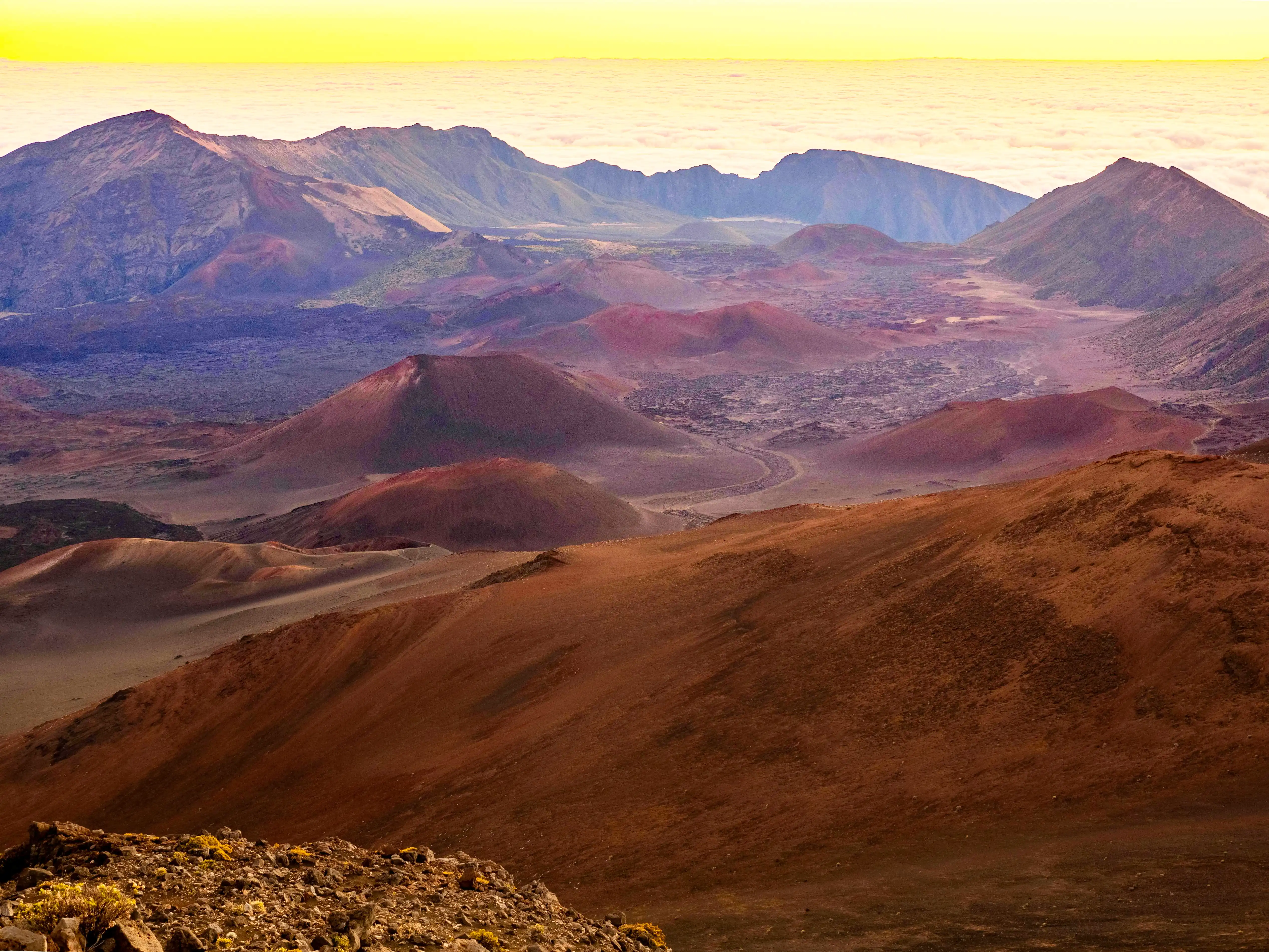
Standing on the floor of Haleakalā Crater, you notice the quiet first. Acoustic experts have measured the ambient sound levels here near the very threshold of human hearing, which means the crunch of your boots on cinder and the low rush of wind across the rim are about all you get. The crater sits at the summit of a 10,000 foot dormant shield volcano, a 3,000 foot deep depression roughly 7.5 miles by 2.5 miles wide. The scale takes time to register.
Much of the crater floor holds the ocher and ashen color of alpine cinder desert, while the eastern reaches shift to lush green with swaths of native fern forest. In between, the terrain moves through red sand, black lava rock, and patches of green vegetation in a gradient that changes noticeably as you move across the valley floor. Cinder cones and dark courses of lava rock mark where past eruptions broke through the surface.
Two species define this place more than any other. The ʻāhinahina, or Haleakalā silversword, occurs only here in this tropical alpine ecosystem, living between three and 90 years and flowering just once before dying. Its silver haired, sword like succulent leaves grow in a low rosette that catches the light differently depending on the angle of the sun. Among the fauna, the nēnē draws most eyes. Hawaii's state bird is a medium sized goose with an estimated population of around 200 in the park, found across high elevation lava flows, volcanic deserts, grasslands, and shrublands.
In summer, flowering silverswords release a sweet and musky scent across the summit on calm afternoons. At any time of year, this is a landscape that rewards slow, deliberate attention.
Getting to the crater
The summit area is reached by the Haleakalā Highway, which winds its way about 10 miles from the main entrance gates up to the crater and viewing areas. From Kahului, take Haleakalā Highway (Hwy 37) east for about 7.8 miles then turn left to continue on Hwy 377 south for another 6 miles to the junction with Crater Road (Hwy 378). Follow Crater Road 20.7 miles to the Haleakalā Visitor Center.
The recommended starting point is the Sliding Sands Trailhead, located near the Haleakalā Visitor Center along Crater Road. Don't underestimate the distance — the road twists and turns with lots of pull-offs, and door to door travel time from most areas of Maui runs 1.5 to 2.5 hours.
When to go for the best light
At 10,023 feet above sea level, this shield volcano offers a surreal spectacle as the sun rises above a sea of clouds, casting molten hues across the crater floor. Sunrise is the most sought-after window and for good reason. The National Park Service requires a sunrise reservation for all vehicles entering the park between 3:00 AM and 7:00 AM, so book through recreation.gov well in advance.
Staying after sunrise is worth it too — the sun continues to rise and light up the crater floor with strong, clear lighting. If an early alarm isn't in the cards, on clear evenings the sun sinks toward the horizon and lights up the rock and cinder cones in deep oranges and reds and no reservations are needed for sunset, unlike sunrise.
Three things to look for on the crater floor
The interior of the crater is dotted by numerous volcanic features including large cinder cones. As you hike down look for color shifts in the rock itself. Sunlight reveals dark basalt lava flows set against red, orange, and green cinder cones.
The Haleakalā silversword grows nowhere else on Earth. Its silvery sword-like leaves reflect sunlight and help the plant conserve water in the high alpine desert. After decades of growth it blooms once before completing its life cycle so a blooming plant is a rare find worth pausing for.
Nēnē (Hawaiian geese) can also be seen in their natural habitat in the crater. The nēnē had become locally extinct but was reintroduced beginning in 1962 and the species is now thriving within park boundaries. Keep an eye on the open ground and low shrub areas as you walk.
Insider Tips
Skip the summit crowd: walk the Halemau'u rim instead
Most visitors cluster at Pu'u Ula'ula (the main summit overlook) and never make it 1.1 miles down the Halemau'u Trail to the crater rim. That short walk puts you at the edge of a 1,000-foot cliff looking directly into the Ko'olau Gap — a view that's wider and more layered than anything from the parking lot above.
Head here in the early morning before clouds build on the northeast side of the crater. The light falls across the cinder cones at a low angle and the scale of the valley floor reads clearly from this vantage.
What to wear on the crater floor
Temperatures at the summit hover between subfreezing and the mid-60s year-round, and the weather shifts fast. Dress in synthetic or wool layers you can peel off as you descend — the crater floor sits around 7,000 feet and runs about 21 degrees cooler than sea level Maui.
Wear ankle-high hiking boots with closed toes. The trail crosses loose cinders, sandy sections and rough lava rock, so open-toed shoes and low-cut sneakers create real problems underfoot. Add a brimmed hat and reef-safe sunscreen: UV intensity at 10,000 feet is significant even on overcast days.
Stop at Grandma's Coffee House in Keokea
On the drive up from Kahului via Kula Highway, pull off in Keokea for a cup at Grandma's Coffee House. The Franco family has been growing Arabica beans on the slopes of Haleakalā and roasting them on-site since 1918 — the coffee here comes from the same mountain you're about to hike.
The café opens at 7am and serves breakfast all day from a chalk-written menu. Get there early if you want the cinnamon rolls or house-made baked goods — they go fast, especially on weekends when live Hawaiian music plays on the lanai.
Nearby Hikes
Trails worth your time when you're in the area.
Keonehe'ehe'e (Sliding Sands) Trail
This is the main route into Haleakalā Crater. The trail starts in the Haleakalā Visitor Center parking lot at 9,740 ft and drops through loose cinder and ash toward the crater floor, with silverswords along the upper section. The crater floor is 3.9 miles one way and about 2,500 ft below the trailhead, so the return climb is the hard part. Many day hikers turn around before the floor, while stronger hikers use this trail for longer cross crater routes. A sunrise reservation is required only for vehicle entry between 3 am and 7 am.
View on nps.govHalemau'u Trail to crater overlook
Starting at the Halemau'u Trailhead at roughly 8,000 ft, this trail crosses native shrubland and a natural lava arch known as Rainbow Bridge before reaching the crater rim at 1.1 miles. From there it descends a series of steep, rocky switchbacks about 1,400 ft down to the crater floor and Holua Cabin. The rim viewpoint offers a wide look into Ko'olau Gap and across the crater that differs noticeably from the summit angles. Most day hikers turn around at the overlook or the cabin. Combined with Sliding Sands as a one way traverse, this route covers 11.2 miles point to point.
View on nps.govPīpīwai Trail to Waimoku Falls
Located in the Kīpahulu District on the southeast coast of Maui — about 12 miles past Hāna — this trail is the other major hike within Haleakalā National Park. It passes Makahiku Falls at half a mile, moves through a large banyan tree grove, and then cuts through a dense bamboo forest before reaching Waimoku Falls, a 400 ft cascade over a sheer lava wall. The terrain includes boardwalk sections, rooted dirt paths, and a stream crossing near trail's end. Mud is common after rain, so sturdy footwear helps. The Kīpahulu District is a 3 hour drive from the summit area.
View on nps.govSliding Sands to Halemau'u traverse
This point to point route links the two main crater trails into a full day crossing of Haleakalā. You start at the summit visitor center on Sliding Sands, descend to the crater floor, cross past cinder cones and the area around Kawilinau (the so-called bottomless pit), then climb out via the Halemau'u switchbacks to a separate trailhead at 8,000 ft. Total elevation gain is about 1,800 ft going this direction. A car shuttle or hitchhike between trailheads is required. Give yourself 5 to 7 hours and start early to stay ahead of afternoon weather.
View on earthtrekkers.comHosmer Grove Loop
A short loop just inside the park entrance at around 7,000 ft, this trail moves through a grove of non-native trees — eucalyptus, cedar, Douglas fir, and others — planted in 1910 as part of an experiment to test timber viability on the island. The grove borders native Hawaiian shrubland, and the area draws a variety of honeycreepers found nowhere else on Earth. It's an accessible option for families or as a warm up before heading higher, with minimal elevation change and a shaded, forested feel that contrasts sharply with the open cinder landscape at the summit.
View on nps.gov
Protecting Haleakalā
Haleakalā is home to more endangered species than any other national park in the United States, with 103 total endangered species across the park including 81 flowering plants, 10 birds, six non-flowering plants, three insects, two mammals, and one reptile. The crater itself shelters some of the most ecologically fragile ground on Earth. A high percentage of living things in Hawaii exist nowhere else in the world, and because these species adapted to a single remote environment, they are often extremely sensitive to threats like invasive species, climate change, and the loss of forested land.
The silversword ('āhinahina) is the crater's most iconic resident. 'Āhinahina occurs only at the Haleakalā crater and summit, lives between three and 90 years, and flowers just once before dying and scattering seeds in the wind. It thrives in the hot, dry aeolian desert alpine zone of the crater. Excessive grazing by cattle and goats and vandalism in the 1920s once brought it to the edge of extinction, but since strict monitoring and governmental protection took effect, the species' recovery is considered a successful conservation story, although threats remain.
The nēnē faces a similar story. An endangered species and the state bird of Hawaiʻi, nēnē are the last remaining species of Hawaiian goose. Habitat loss, hunting, and the introduction of mammals caused the bird population to dwindle, with only around 2,000 birds left as of 2010. Meanwhile, the greatest ongoing threat to native birds is the invasive Culex mosquito, which carries avian malaria and, as climate change warms higher elevations, is pushing further into mountain forests where birds once had refuge.
Places like Haleakalā's crater floor hold species that evolved over millions of years in isolation. Once gone, those evolutionary lineages cannot be recovered. Protecting this landscape keeps that biological record intact for the people and scientists who come after us.
At Rainier Hat Co., selling hats is the mechanism, not the mission. Every hat in our collection exists to route money directly to the parks that need it. When you pick up the Haleakalā hat, 100% of the profit goes straight to the National Parks as a donation. No middlemen, no overhead cuts. Just a hat that does real work.