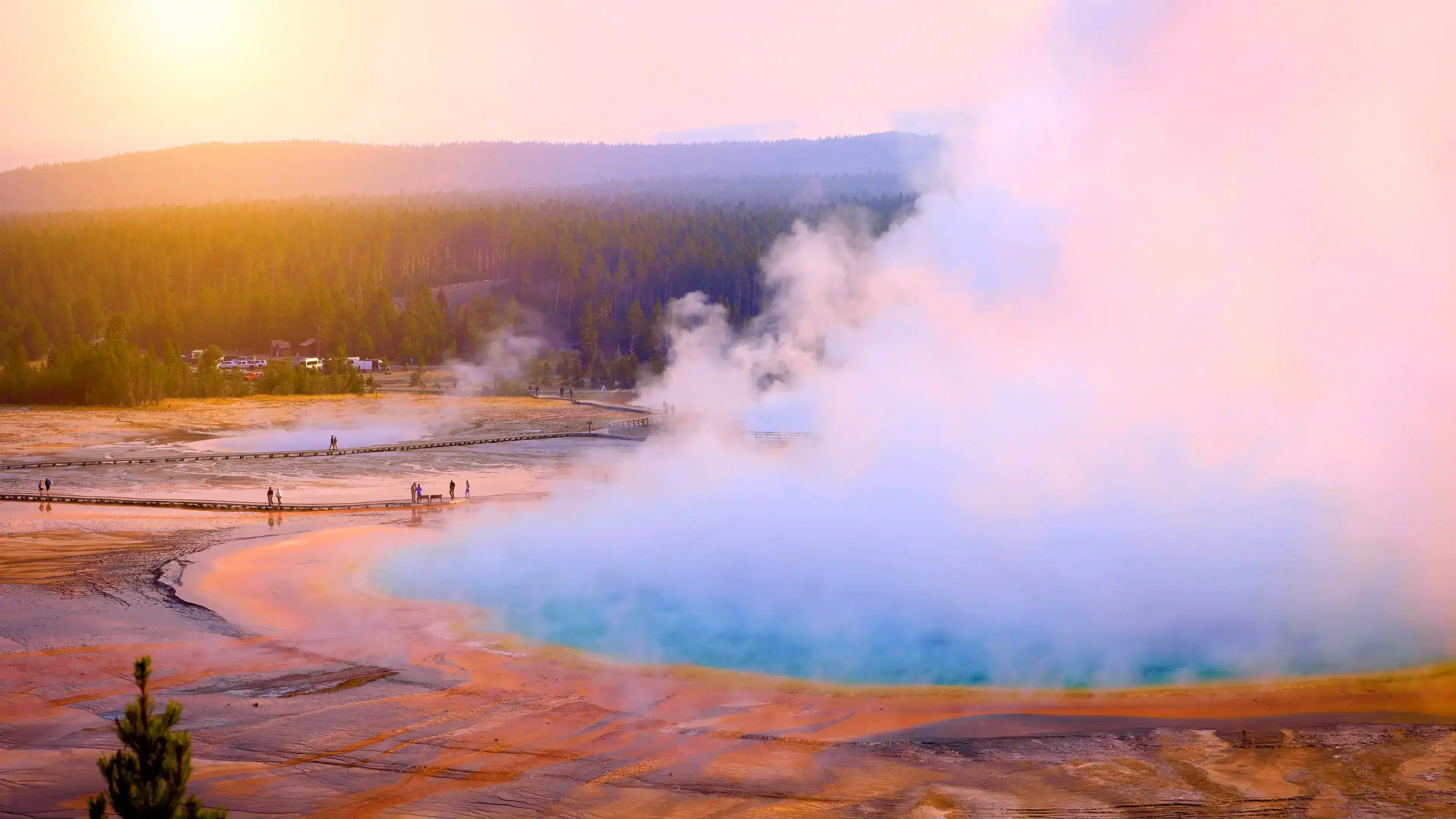
Grand Prismatic Spring, Yellowstone National Park
- Best time of year: Visit between May and September, with June through August offering less steam and the most vivid colors.
- Best time of day: Aim for midday, once the mist burns off. Yes, it will be crowded, but the colors are worth it.
- Two ways to see it: Walk the boardwalk through Midway Geyser Basin to get close to the spring, or hike the Grand Prismatic Spring Overlook Trail for a bird's eye view of the full spring and its colors.
- Extend your hike: Combine the overlook with the Fairy Falls hike since they share the same trail. The full trip is 5.4 miles round trip with 120 feet of elevation gain, rated easy.
- Getting there: Park at the Fairy Falls Parking Lot, not the Grand Prismatic/Midway Geyser Basin lot, which only serves the boardwalk. The Fairy Falls lot is larger but fills up fast.
Grand Prismatic Spring is the largest hot spring in the United States and one of the most geologically active places you can walk up to on a boardwalk. It measures roughly 250 by 300 feet across and drops 160 feet deep, which means you are looking at a body of water large enough that the far edge registers more as a horizon than a shore.
The air carries a sulfur smell that varies with the wind, and water at the center reaches about 189°F, making it sterile, which accounts for the deep blue color at the core while the cooler outer edges support vivid microbial life. That color gradient is the spring's defining feature. The center reads deep blue because of how the water absorbs light, and as it spreads outward and cools it creates the right conditions for heat loving bacteria to take hold, producing zones of green and yellow closer in and orange and red at the outer edges.
Those colors come entirely from microbial mats of thermophilic bacteria and archaea, and the ratio of chlorophyll to carotenoids in those mats determines what color each zone appears. The mats shift with the seasons too: in summer the microbes produce darker red and orange pigments in response to intense sunlight, while in winter green photosynthetic pigments take over.
Thermal steam drifts across the surface and can obscure the view entirely on cooler mornings. Bison, elk, and the occasional grizzly bear move through the surrounding area, and bison sometimes cross the boardwalks themselves. The scale of the place only becomes clear when other visitors come into frame, small figures on a narrow wooden path at the edge of something ancient and still very much in motion.
Visiting Grand Prismatic Spring
Getting there
Grand Prismatic Spring sits in Midway Geyser Basin, about 7 miles north of the Old Faithful Visitor Center along Grand Loop Road. You have two access points. For the boardwalk, pull into the Midway Geyser Basin parking lot directly off the road. From there, a wooden boardwalk crosses the Firehole River and winds through the basin. For the elevated overlook, drive 1 mile south of Midway Geyser Basin to the Fairy Falls parking lot, then follow the trail as it climbs 105 feet over 0.6 miles to a view looking down on the spring. Note that the Fairy Falls lot is separate from the Midway Geyser Basin parking area. There is no connecting trail between the two. Both lots fill up fast during peak season so plan to arrive early.
Best season and time of day
The spring is most accessible between May and September, and narrowing it down further, June through August offers less steam and the most vivid colors. The best time of day is late morning to early afternoon when the sun is high. While crowds are lighter early or late in the day, you want bright sunlight to really bring out the color. Cooler morning and afternoon air creates more steam and reduces visibility. The colors also shift with the season depending on water temperature and which microbes are active, so expect vibrant yellow, orange, and green in summer and more muted brown and orange tones in winter.
Three things worth slowing down for
First, look at the color bands from the boardwalk. The spring produces a distinct color gradation where each temperature zone gives way to a different microbial community. Each band of color corresponds to a different temperature range and a different group of heat tolerant bacteria. Second, watch the runoff channels flowing away from the spring's edge. In these channels you'll find mats of photosynthetic cyanobacteria that shift between orange and green depending on the season. Third, look for the pale white gray zones around the perimeter of the spring where silica compounds dissolved in the water precipitate out and deposit as siliceous sinter. It's a slow geological process you can see happening in real time.
Insider Tips
Skip the main overlook: walk the Fairy Falls trail instead
The official Grand Prismatic Spring Overlook sits at the end of a 1.2 mile round trip trail starting from the Fairy Falls parking lot, about a mile south of the Midway Geyser Basin turnoff along Grand Loop Road. From the platform you can see the full width of the spring and its color bands in a way that the crowded boardwalk at ground level simply does not allow.
Timing matters more than most people expect. Steam rising off the water can obscure the color rings entirely in the morning, and it usually does not burn off until around midday. Plan to hit the overlook between late morning and early afternoon on a clear, sunny day for the clearest view of the color gradient.
What to wear
Bring sturdy trail shoes with grip. The path to the overlook is mostly flat gravel but the final climb to the platform is short and steep, and the loose surface gets slippery. Layers are worth the extra pack weight since temperatures near the thermal features can feel warmer than the surrounding area, but wind picks up once you reach the exposed platform.
Sun protection is easy to underestimate at this elevation. A hat with a brim and sunscreen make a real difference, especially if you plan to combine the overlook with the full Fairy Falls hike, which adds roughly 4 miles to your day.
Stop in West Yellowstone first: Mountain Mama's Coffeehouse and Bakery
If you are coming from the west entrance, West Yellowstone, Montana sits right at the park gate and makes a natural fueling stop before you head in. Mountain Mama's Coffeehouse and Bakery at 17 Madison Ave is a locally owned spot that opens at 7 a.m. on weekdays and serves locally sourced wild game breakfast burritos, fresh baked pastries, and a full espresso bar.
Their grab and go box lunches are worth ordering ahead if you want to eat inside the park without hunting for food mid-day. Grand Prismatic is only about a 20 minute drive from the West Entrance, so you have time to eat, fuel up, and still reach the Fairy Falls trailhead before the late morning crowds arrive.
Nearby Hikes
Trails worth your time when you're in the area.
Midway Geyser Basin boardwalk
This short boardwalk loop puts you right at the edge of Grand Prismatic Spring and the Excelsior Geyser Crater. Thermophilic microbes color the runoff channels in bands of orange, yellow, and green as water cools away from the source. The spring measures roughly 370 feet across and sits more than 120 feet deep, making the scale hard to process from ground level. Afternoon visits on clear days give you the best chance of seeing the colors without steam blocking the view.
View on nps.govGrand Prismatic Spring overlook
A short spur off the Fairy Falls Trail climbs 105 feet over 0.6 miles to a purpose-built overlook platform above the Midway Geyser Basin. From here you can take in the full geometry of Grand Prismatic Spring: its concentric rings of color produced by thermophilic mats that shift from orange and red in summer to darker green as temperatures drop. The aerial perspective reveals what the boardwalk below cannot. Come after midday when steam has largely dissipated.
View on nps.govFairy Falls
Starting from the Fairy Falls Trailhead just south of Midway Geyser Basin, this nearly flat out-and-back trail crosses the Firehole River on a steel truss bridge built in 1911 and follows an old freight road through young lodgepole pine forest. At 1.6 miles from the trailhead, Fairy Falls drops 200 feet in a narrow, slender cascade into Fairy Creek. You can add the Grand Prismatic Spring overlook on the way out or back, which tacks on about a quarter mile and 100 feet of gain. Parking fills quickly by mid-morning.
View on nps.govMystic Falls loop
The trail begins at Biscuit Basin about 3 miles north of Old Faithful and passes through the basin boardwalk before entering a mixed conifer forest along the Little Firehole River. At roughly 1.2 miles, Mystic Falls cascades 70 feet down a series of rock ledges. Continuing past the falls on the loop option climbs a series of switchbacks to an overlook of Upper Geyser Basin, where on a clear day you can watch Old Faithful erupt in the distance. The descent back to the basin is steep, so good footwear matters.
View on nps.govLone Star Geyser
This out-and-back trail south of Old Faithful follows a paved bike path along the Firehole River through a quiet stretch of forest. The destination is Lone Star Geyser, a backcountry cone geyser that erupts roughly every 3 hours to a height of about 45 feet. A log near the cone lets hikers record the last eruption time so you can plan your arrival. The trail sees far fewer visitors than the nearby geyser basins, making it a good option when crowds at Grand Prismatic feel like too much.
View on nps.govEmbroidered Yellowstone National Park Hat - 100% of profits donated to National Parks
100% of the profit from every hat goes straight to the National Parks. Not a round-up. Not a percentage. The whole margin.
Shop this hatEstimated delivery Oct 19 to Columbus, OH
Protecting Yellowstone
Grand Prismatic Spring sits within Yellowstone, a UNESCO World Heritage Site, and its conservation depends on protecting one of the most fragile ecosystems on the planet. Park staff closely monitor the microbial communities that give the spring its color, as these organisms are extremely sensitive to environmental changes and human interference. Damage to the bacterial mats can take more than a year to naturally repair itself, which is why staying on boardwalks isn't just a rule but an act of stewardship. Researchers study the unique microbial life here for insights into extremophiles and the potential for life in similar conditions elsewhere in the universe, meaning what lives at the edge of this spring carries scientific value that extends far beyond the park boundary.
Preserving places like Grand Prismatic Spring ensures that future generations inherit not just a landscape to visit but a living laboratory that continues to generate knowledge. Prior research on heat-resistant microbes has already led to medical and forensic advancements, including the development of the polymerase chain reaction (PCR). That kind of discovery only happens when ecosystems remain intact.
At Rainier Hat Co., we exist to fund that protection. We're not a souvenir company that happens to donate; we're a funding vehicle for the parks that happens to sell hats. Every dollar of profit from the Yellowstone National Park Hat goes directly to the National Parks, 100%. Buying one isn't just a way to remember the trip; it's a way to keep the place worth remembering.