Ruby Beach, Olympic National Park
- Ruby Beach sits on the Washington coast about 3 hours from Seattle via US-101, with the nearest town being Forks
- Summer (June through September) brings the driest weather and longest daylight for exploring tide pools and sea stacks
- Low tide is the best time to walk out toward Abbey Island and examine the intertidal zone up close
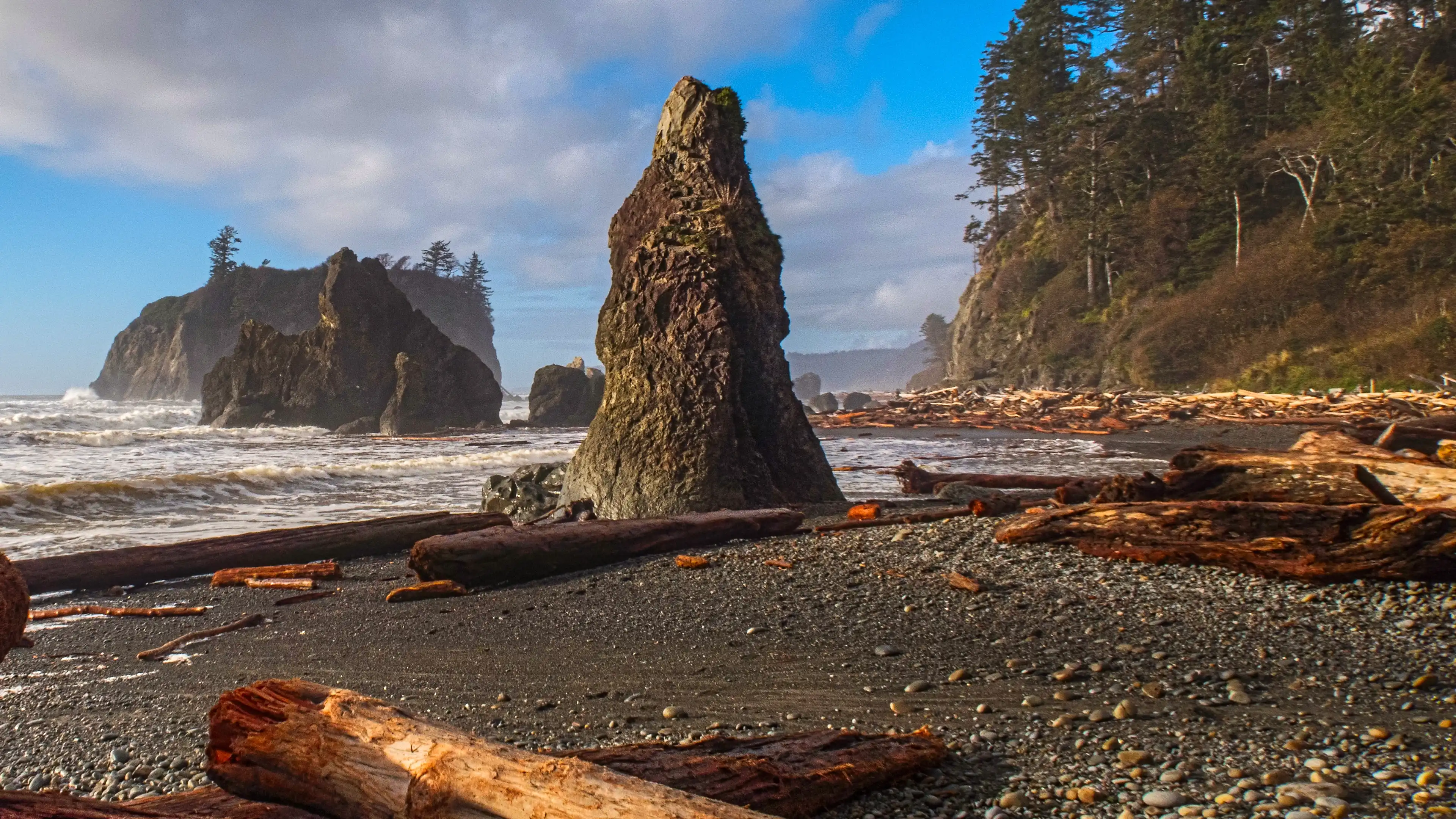
- Driftwood logs, scattered rock formations, and the creek outlet at the north end of the beach give you plenty to explore on foot
- Arrive early or on weekdays to find parking at the small trailhead lot, which fills quickly during peak season
Ruby Beach earns its name from the faint reddish tint in the sand, a product of garnet minerals eroded from coastal rock and sorted by wave action over countless tidal cycles. Stand at the waterline and you are looking at a beach that operates at a scale most coastal spots in the lower 48 simply do not reach.
The sea stacks here rise directly from the surf, dark basalt columns draped in mussels and sea anemones at their bases, with Abbey Island anchoring the southern end of the beach in a mass of forested rock that the tide cuts off from the shore at high water. The air carries the smell of kelp and salt and the particular cold sharpness that comes off the North Pacific even in summer. Waves move through at irregular intervals, some breaking well offshore against submerged reef, others reaching the driftwood line.
The logs scattered across the upper beach are full-sized conifers, stripped of bark and bleached pale gray, deposited by winter storms and river floods over decades. They give the beach a raw, unmanicured quality that separates it from anything you find farther south along the coast.
Black oystercatchers work the exposed reef at low tide, their orange bills visible from a distance. Bald eagles patrol the treeline at the beach edge. In the right season, gray whales pass close enough to the shore that you can track their spouts from the sand without binoculars.
Ruby Beach does not look managed. That is exactly the point.
Visiting guide for Ruby Beach, Olympic National Park
Getting there
Ruby Beach sits directly off US-101 on the northern edge of the Olympic Peninsula, roughly 27 miles south of Forks. The signed parking area is small and fills fast in summer, so aim to arrive before 9am or after 4pm on weekdays if you can. From the lot, a short forested trail drops you onto the beach in about five minutes. No permits are required for day use, though a National Parks Pass or entrance fee applies.
When to go
Late summer through early fall gives you the most reliable light and the lowest chance of fog burning in from the Pacific before you can make use of it. Sunset here tracks northwest, meaning the light hits the sea stacks and Abbey Island at a low angle in the final hour before dark. That said, the overcast light common from November through April diffuses shadows and brings out the texture in wet gravel and kelp-covered rock in ways that direct sun does not. Low tide aligned with golden hour is the combination worth planning around.
Details worth slowing down for
The reddish tint in the sand comes from garnet and other heavy minerals eroded out of the coastal rock and sorted by wave action over time. Watch for black oystercatchers picking along the exposed reef near Abbey Island at low tide. They are loud, stocky shorebirds with bright orange bills that are hard to miss once you know what to look for. Also take a few minutes at the creek outlet on the north end of the beach where fresh water braids across the gravel before reaching the surf, drawing shorebirds and providing a natural foreground element that most visitors walk right past.
Insider Tips
Walk north to the creek outlet for a less crowded frame
Most visitors drop onto the beach and head straight for the sea stacks near the trailhead. If you walk north past the driftwood piles and continue toward the far end of the beach, you reach a small creek that braids across the gravel before emptying into the surf. The shallow water creates natural reflection pools at low tide with nothing but open coastline and sky in the frame. Few people make it that far, so you get the light to yourself.
Wear waterproof trail runners and pack a wind shell
The surface at Ruby Beach shifts quickly between dry sand, wet gravel, kelp-covered rock, and driftwood piles that can be slippery underfoot. Waterproof trail runners or low hiking boots give you the grip and protection to move across all of it without second-guessing each step. A wind shell goes in the pack regardless of the forecast since the marine layer moves in fast and the temperature at the waterline drops noticeably even on clear afternoons.
Stop at Olympia Coffee Roasting Co. on the way out of town
The drive from Seattle to Ruby Beach is just over three hours and Olympia sits almost exactly at the halfway point on US-101. Olympia Coffee Roasting Co. at 600 4th Ave E has been roasting direct trade coffee since 2005 and opens at 6:30am on weekdays, which lines up well if you leave Seattle early to beat traffic. Grab a bag of beans to brew at camp and a drink for the road.
Nearby Hikes
Trails worth your time when you're in the area.
Rialto Beach to Hole in the Wall
The route follows the beach north from the Rialto Beach parking area, crossing Ellen Creek around the 0.8 mile mark before reaching Hole in the Wall, a large natural arch carved through a basalt headland. The walk is flat but the cobblestone and sand surface requires steady footing. Plan around a low tide so the arch and surrounding tide pools are accessible. Dogs are permitted on the beach up to Ellen Creek but not beyond.
View on wta.orgSecond Beach
A short forested trail drops from the trailhead down switchbacked stairs to one of the more dramatic beaches on the Olympic Coast. Sea stacks rise from the surf to the south and a natural arch sits at the north end of the beach. The return trip gains around 200 feet back to the parking area. Go at low tide to access the tide pools near the base of the rock formations. Dogs are not permitted on this trail.
View on wta.orgHoh River Trail to 5 Mile Island
The Hoh River Trail runs through one of the few remaining temperate rainforests in the contiguous US, following the milky, glacier-fed Hoh River through old growth Sitka spruce and western hemlock. The first 12 miles stay mostly flat, making 5 Mile Island a natural day hike turnaround where a large gravel bar opens up the valley. Roosevelt elk are commonly seen along this stretch. A wilderness permit is required for overnight camping.
View on wta.orgHall of Mosses
This short loop at the Hoh Rain Forest Visitor Center passes through a grove of big leaf maples draped in club moss, moving through old growth forest on a well-maintained path. It is one of the most visited trails in Olympic National Park and works well as a complement to a Ruby Beach trip since the Hoh Rainforest is about 20 miles inland via Upper Hoh Road. The trail stays open year-round and is suitable for most ability levels.
View on wta.orgThird Beach
The trail descends through old growth coastal forest before dropping steeply to a long, isolated stretch of sand framed by forested bluffs and offshore sea stacks. Strawberry Bay and Toleak Point are visible to the south, and the beach sees far fewer visitors than nearby Second Beach or Rialto. Overnight camping is permitted with a backcountry permit, and the relative solitude makes it worth the slightly longer approach.
View on wta.orgEmbroidered Olympic National Park Hat - 100% of profits donated to National Parks
100% of the profit from every hat goes straight to the National Parks. Not a round-up. Not a percentage. The whole margin.
Shop this hatEstimated delivery Oct 24 to Columbus, OH
Protecting Olympic
Olympic National Park protects one of the last stretches of wilderness coastline in the contiguous United States where old growth forest, free-flowing rivers, and open ocean meet without significant development in between. The intertidal zones at Ruby Beach support species that are sensitive to foot traffic, water quality changes, and the removal of organisms from tide pools. Rangers ask visitors to stay on wet sand and avoid stepping on exposed reef for good reason: recovery in these zones is slow and the food web is tightly connected. The park's wilderness designation keeps the surrounding forest intact, which in turn keeps the rivers clean and the sediment and mineral supply to beaches like this one functioning as it has for thousands of years. Future visitors will only experience what we leave undisturbed.
At Rainier Hat Co., we operate as a funding vehicle for the parks rather than just a gear brand. Every Ruby Beach hat we sell generates 100% of its profit as a direct donation to the National Parks. When you pick up one of our hats, you are putting money toward the places that make trips like this one possible.